
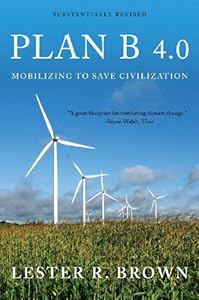
I recently finished reading the book Plan B 4.0: Mobilizing to Save Civilization by Lester Brown. This book has lots of ideas and generates more; it has been a challenge to pare them down to what you see here. This can be a difficult read due to the style of writing. Brown delivers multiple factoids on a theme and then tries to extrapolate a conclusion from the group. Sometimes with productive results, sometimes not. This read also requires an open mind to obtain the useful bits of information, so a couple of warnings:
First, he uses the concept of climate change prominently, both as a cause for some of his observations and as reasoning for many of his suggested actions and timelines. I bring this up not to discuss the validity of the theory in this forum, but as something to be aware of as a major component of the book.
Second, with all of the statistics and case studies he presents from all over the world it can be a little difficult to maintain perspective and keep in focus how different locations have different problems and call for different solutions. Both perspectives are important because with environmental issues the challenge is to think globally and act locally.
Overall, he has a decent collection of bits of information. For a quick primer of worldwide environmental concerns, this is a decent place to start. Where I think he misses the mark--and also where the engineering profession could be stepping in--is his plan. He starts with a problem, for example: our dependence on coal and oil for the production of electricity. He then identifies a solution, in this case he is a champion of wind turbines. Finally, he jumps to the end, by proposing that by focusing enough capital and resources wind turbines can become the main source of energy in the clean and efficient future. There is little discussion of the potential technological problems or any difficulty there would be convincing the nation that such an investment is a good idea.
I would like to highlight a few good ideas that with minimal input (where engineers could play a pivotal role) would have significant impacts on their environments and a conversation starter.
Robert Szczesniak
I currently work for UOP as a Chief Technical Advisor. This includes traveling globally to customer sites to lead teams responsible for start-up, turnaround, or revamp project involving UOP technologies. My experience is primarily in Aromatics with exposure to all aspects of refining. Prior to UOP I worked as an environmental consultant gaining extensive experience in project management, report writing, regulation, data analysis, and field work.
Comments
I think you raise a lot of great points in this. Regarding the first question - do people really want to live that close together? That is a tough one. A lot of people leave the cities not just because of the inhibiting costs (which would be rectified by your suggestion) but because of the crowds. Some people long for a nice house in the countryside. I think it could work very well for people who like and want to live in cities anyway, but there are many people out there who have trouble with crowds and small spaces - we would still have the suburbs, but every little bit of energy savings counts, right?
- Log in to post comments
Thanks for the read, Richard.
I think one of the more difficult ideas you talk about is the cradle-to-cradle concept. The energy business is both profit driven and highly segmented according to the different stages of the energy life cycle (e.g. the company producing the energy technology is not the company producing the energy itself and neither is the infrastructure supplier who provides the energy to the end user). Each company/contractor/producer will be looking to get the best consumer response for their piece of the pie, which makes it difficult to procure the informaton required to determine full life cycle costing. It's worth thinking about, though.
Thanks again for the post.
- Log in to post comments
There are many variables to consider in the cradle-to-grave pricing program - and the most contentious could be the perspectives of competing forces in the market. Some governments in Europe have approached this with high disposal costs to be paid by the manufacturer (if you make a disposable product, you are charged up front for the disposal) - which then gets passed to the consumer. People are less likely to junk old electronics just because the new color came out if there is a price attached. A key point to the cradle-to-cradle is that the product is designed so that it is not disposed of when the consumer is done, it can be transformed into another product. An old example is Henry Ford specified measurements on the lumber for the shipping crates of incoming parts. The crates were then disassembled and used as the running boards on his trucks. No waste to dispose of.
I think another easy solution would be a deposit on certain products with high toxic potential. So if you buy an piece of electronics there is a $50 (for example) fee. When you are ready to replace the product, you take it to a processing facility that will reclaim the metals and materials for recycling and get your deposit back. Keeps everything out of the landfill.
- Log in to post comments
I think the deposit is an interesting idea. I am wondering though because many people sell their old sets on craigslist or bring them to second hand stores - it would be great to use an item until it is no longer functional and then process it - many communities have recycling centers or recycling days to help people dispose of hazardous household chemicals and electronics safely. However, some of them charge to recycle some items, which discourages rather than encourages recycling (for some people, the extra $20 means more).
- Log in to post comments
Even places that take the waste for free are usually not open at good times. The Chicago center is open on Thursday mornings and Saturday afternoons (or something like that, it has been a while). It requires more planning and effort than most people are going to put forth - especially when the alternative is putting it on the curb. With some work to the system of who bears disposal costs, there could be some real redirection of incentives.
- Log in to post comments
Thanks for this post, Robert!! I really enjoyed reading through the review and I'm about to head to Borders after work and pick up the book myself. I'm particularly fascinated by the off grid energy production concept. I traveled to Australia last year studying energy and the environment under UNSW. The program was an amazing experience and it was rewarding because I was given the opportunity to see off grid energy production at work first hand and other renewable technologies fully implemented in the Australian society. The indigeneous people of Australia primarily live in the center of Australia where energy and water is very scarce. Instead of requiring the community to travel and buy petrol for their energy needs, a governmental program called BushLight installs solar panels in these communities and teaches the people how to control and maintan a unit free of charge. I thought it was such a wonderful way to produce off energy production and the concept covered in the book seems to have hit the main point perfectly. Here's the website to the BushLight program: http://www.bushlight.org.au/default.asp?home
- Log in to post comments
Thanks for the resource, that is such a great solution - using the strengths of the location to solve a challenge. Programs like these can really head off a lot of potential emissions and demand as developing economies come on-line.
- Log in to post comments
Great summary, Robert. I agree that convincing tax payers to invest (or whomever) in a new, promising technology is a big hurdle. Unfortunately, topics such as alternative energy and climate change are highly polarizing to the public. Discussions often boil to down emotional melees that are fueled by hasty generalization and half-truths.
- Log in to post comments
Thanks, couldn't agree more. I think that the facts should be able to stand alone. But often everything gets boiled down to a 30 second soundbite that people rant over. But that is where true leadership comes in (government, private sector, where ever) - getting people to work for a better future before it becomes painfully obvious.
- Log in to post comments
Agreed! The biggest enemy in all of this is ignorance. People don't understand the data or the facts and even in the face of overwhelming evidence will still deny what is really going on. I guess the reality they have come to believe in is just more convenient than the truth.
- Log in to post comments
Looks like I have to read this book to understand better. I can see tthat he authors had used / discussed all the relevant sustainability topics in this book. Things like cap and trade can be seen as a leadership might or new politico-economic barriers. I still belive we have to develop a methodology to do cradle to grave analysis, given its limitations as some of the boundaries could be inaccessible. Nevetheless, the benefits of LCA will be great to humanity.
- Log in to post comments
A lot of the proposals have significant drawbacks or difficulties given the complexity of the problem. Life cycle analysis is a great way to breakdown the problems and create a better design that serves everyone better. A really great resource on this topic is 'Cradle to Cradle' by William McDonough and Micheal Braungart. Rethinking product design starting from the premise that products shouldn't have one use or lifetime. But once done with the original intent it can be used for many other uses.
- Log in to post comments
Thanks for the reply, Robert (and a HUGE apology for calling you Richard in my first comment - mortified - can I blame my small mobile screen?!).
In my home city (in Canada) they had recycling for years which worked on the deposit system you describe. The unfortunate thing is that, because it required the extra trip, recycling didn’t really take off until the city implemented the systems and infrastructure required to pick up people’s recycling from their doorstep. It had to be convenient. Apparently the promise of getting the deposit back was never enough to encourage people to go out of their way to return the goods.
I think that building the cost of disposal or recycling into the cost passed to the consumer is an excellent way to illustrate a little more cause and effect to the end user, and I agree that it would have the effect of minimising the ‘replace it for a different colour’ mentality. The only problem I see is that most producers are unlikely to do such things unless it is regulated by the governing body. There are very few capitalist organisations that genuinely put social conscience ahead of shareholder value if given the choice – and why should they unless their shareholders ask it of them? Maybe the real way forward is a combination of population power and choosing the right shareholders for our corporations. Just a thought.
- Log in to post comments
I think thats a great thought. We still live in the Land of the Bottom Line and corporations don't do anything unless they get something good out of it (good PR, isn't necessarily enough these days). There are some companies out there that sell more expensive products based on "every purchase we donate $1 to the amazon" or "made of fully recycled materials" but that doesn't take into account the end of life of those products. I agree that unless it is attractive enough to do so, public companies will not put the social good ahead of short term profits.
- Log in to post comments
No worries - thanks for coming back! There is definitely a challenge in finding that fine line between motivating people to get involved and punishing them financially. Figuring out how to motivate the general population is sometimes more of an art than a science. Sometimes it works better as a mandate and sometimes it works better as a grassroots movement.
As for getting companies to act with a social conscience, you are right there are not many. But there are a few. I think there are some products and regions that can support companies with a conscience. But like ehorahan said - it is real hard to separate the really deal from green-washing. Some food companies and (probably the easiest market for this) baby product companies have had success. There, being able to trust a company's intentions, sources, and production has a real cash value and can be beneficial to the bottom line. And smaller companies can be viable. But other products, like electronics, that is a much harder sell - so either we need a company willing to take a cut out of their profits or we need to get enough people thinking the same way to create a market. People vote with their dollars on every purchase.
- Log in to post comments
Well-deserved thanks go to Lester Brown for his devotion to Life as we know it. Without his insight, research, and distribution of the facts, many of us (and my students) would carry on as if everything is o.k. And it's not. Right now, I am mourning over the horrific oil spill in the Gulf of Mexico. Nothing will ever be the same in the Gulf.
- Log in to post comments
Hopefully, we can use that horrible mishap - as well as some of the concepts from this book - as motivation to think about extended consequences of our actions.
- Log in to post comments
Thanks for reading. Be sure to check out other books related to manufacturing like Cradle to Cradle - great ideas on using design to remove waste from the system.
- Log in to post comments