
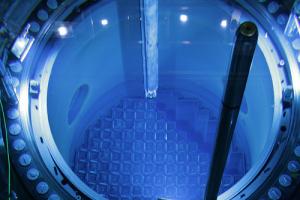
 Reactor vessel in Ringhals nuclear power plant
In March 1979, the American Institute of Chemical Engineers published a policy statement in Chemical Engineering Progress supporting reprocessing spent nuclear fuel and disposing the waste in a geologic repository. The AIChE concluded that viable technical solutions already existed at that time for the problems of high level nuclear waste disposal and that government uncertainties were the source of delay.
Thirty years later, little expansion of nuclear power has occurred even though it has demonstrated continually improved safety and economic viability.
During this period, disposal of high level nuclear waste has remained a government responsibility but a long-term spent fuel disposition pathway has not been defined. As a result there is no current high-level waste disposal repository under consideration nor is there an operating commercial nuclear fuel recycle facility. Today, the perceived threat of global climate change and the U.S.'s reliance on imported energy sources presents an opportunity in which nuclear power has become increasingly attractive for base-load electricity generation. Additionally, the Department of Energy has recently announced the formation of a Blue Ribbon Commission to recommend a safe, long-term solution to managing the Nation's used nuclear fuel and waste.
In 2009, the AIChE re-visited its policy on nuclear power and the fuel cycle. This position statement is the result of our investigation. The purpose of the statement will be to inform key stakeholders and decision makers (e.g. the Blue Ribbon Commission) of AIChE's position on spent nuclear fuel management and in doing so put ourselves forward as an informed, non-partisan professional body which stakeholders and decision makers may access to help them.
The lead author for the AIChE Nuclear Engineering Division Position Statement is Dr. Stuart Arm, the 2009 Nuclear Engineering Division Chair, but significant contributions from the Nuclear Engineering Division Executive Committee and collaboration with the Government Relations Committee are acknowledged.
Reactor vessel in Ringhals nuclear power plant
In March 1979, the American Institute of Chemical Engineers published a policy statement in Chemical Engineering Progress supporting reprocessing spent nuclear fuel and disposing the waste in a geologic repository. The AIChE concluded that viable technical solutions already existed at that time for the problems of high level nuclear waste disposal and that government uncertainties were the source of delay.
Thirty years later, little expansion of nuclear power has occurred even though it has demonstrated continually improved safety and economic viability.
During this period, disposal of high level nuclear waste has remained a government responsibility but a long-term spent fuel disposition pathway has not been defined. As a result there is no current high-level waste disposal repository under consideration nor is there an operating commercial nuclear fuel recycle facility. Today, the perceived threat of global climate change and the U.S.'s reliance on imported energy sources presents an opportunity in which nuclear power has become increasingly attractive for base-load electricity generation. Additionally, the Department of Energy has recently announced the formation of a Blue Ribbon Commission to recommend a safe, long-term solution to managing the Nation's used nuclear fuel and waste.
In 2009, the AIChE re-visited its policy on nuclear power and the fuel cycle. This position statement is the result of our investigation. The purpose of the statement will be to inform key stakeholders and decision makers (e.g. the Blue Ribbon Commission) of AIChE's position on spent nuclear fuel management and in doing so put ourselves forward as an informed, non-partisan professional body which stakeholders and decision makers may access to help them.
The lead author for the AIChE Nuclear Engineering Division Position Statement is Dr. Stuart Arm, the 2009 Nuclear Engineering Division Chair, but significant contributions from the Nuclear Engineering Division Executive Committee and collaboration with the Government Relations Committee are acknowledged.
Stuart Arm
Director, Applied Technology
Energy Solutions
Dr. Stuart T. Arm has a PhD and MEng in Chemical Engineering from Imperial College of Science and Technology, United Kingdom. His PhD and the first years of his career were spent with the United Kingdom Atomic Energy Authority at Harwell, United Kingdom, developing and evaluating process technologies for advanced reprocessing of spent nuclear fuel. Dr. Arm has lived in the USA since 1994 where he became involved in nuclear waste processing and immobilization technology development at the Hanford nuclear site in Richland, Washington. As national interest in nuclear energy renewed, Dr. Arm went to work at the Pacific Northwest National Laboratory in 2001 where he again developed and evaluated technologies for recycling spent nuclear fuel. He joined EnergySolutions in 2007 as their Separations Technology Director with a focus on the company’s nuclear fuel cycle activities. He has been a member of the American Nuclear Society since 2004 and was the American Institute of Chemical Engineers Nuclear Engineering Division chair for 2009.
Reactor vessel in Ringhals nuclear power plant
In March 1979, the American Institute of Chemical Engineers published a policy statement in Chemical Engineering Progress supporting reprocessing spent nuclear fuel and disposing the waste in a geologic repository. The AIChE concluded that viable technical solutions already existed at that time for the problems of high level nuclear waste disposal and that government uncertainties were the source of delay.
Thirty years later, little expansion of nuclear power has occurred even though it has demonstrated continually improved safety and economic viability.
During this period, disposal of high level nuclear waste has remained a government responsibility but a long-term spent fuel disposition pathway has not been defined. As a result there is no current high-level waste disposal repository under consideration nor is there an operating commercial nuclear fuel recycle facility. Today, the perceived threat of global climate change and the U.S.'s reliance on imported energy sources presents an opportunity in which nuclear power has become increasingly attractive for base-load electricity generation. Additionally, the Department of Energy has recently announced the formation of a Blue Ribbon Commission to recommend a safe, long-term solution to managing the Nation's used nuclear fuel and waste.
In 2009, the AIChE re-visited its policy on nuclear power and the fuel cycle. This position statement is the result of our investigation. The purpose of the statement will be to inform key stakeholders and decision makers (e.g. the Blue Ribbon Commission) of AIChE's position on spent nuclear fuel management and in doing so put ourselves forward as an informed, non-partisan professional body which stakeholders and decision makers may access to help them.
The lead author for the AIChE Nuclear Engineering Division Position Statement is Dr. Stuart Arm, the 2009 Nuclear Engineering Division Chair, but significant contributions from the Nuclear Engineering Division Executive Committee and collaboration with the Government Relations Committee are acknowledged.
Comments
I am trying to learn more about the nuclear energy and its applications. Is there any application demonstrated where we could use the heat generated in nuclear reactors to carry out endothermic reactions? I would also like to see whether we can use this energy to split water to make hydrogen for fuel cell or any other clean fuel applications. Any research directed toward that effort?
- Log in to post comments
Great article! One issue is that many universities have eliminated their nuclear engineering programs (my alma mater included) to make room for other more glamourous majors like biomedical engineering that currently attract more undergrads. I had the pleasure of touring my school's old (and shut down) nuclear reactor facility - though all the nuclear stuff was gone, the tour was insightful and interesting! Schools will need to start up nuclear programs again to feed the demand for nuclear engineers that will arise from the building of more nuclear facilities.
- Log in to post comments
The US has not had a consistent energy policy in decades and nuclear energy seems to be the most obviously damaged industries. Without a clear plan companies can not invest in these large scale plants and with the demand for engineers gone, so go the programs, and so goes any expertise we have in the area. The continued stalling will only make things worse.
An interesting alternative to the large scale plants are the small, neighborhood sized plants. They take up the size of a small car. Can be delivered to a site in a turn-key setup. Have enough power for a neighborhood, and when the fuel is spent they can be shipped as a whole unit for reprocessing. These are more versatile and cost effective for developed and developing areas.
- Log in to post comments
Robert - Those small plants sound fascinating! Can you post any more info about them?
I would worry that people would pull a Not-In-My-Backyard (or in this case a Not-In-My-Driveway). Its got to be in somebody's backyard, all the buildings and infrasctructure that provide us with the lifestyle we come to expect. Everyone wants it, but no one wants to see it.
- Log in to post comments
Sorry for the super late response, but work has been crazy lately. There are plenty of sources on the internet, search for 'small', 'modular', or 'neighborhood' 'nuclear reactor'. Here are a couple to get you started - http://www.businessweek.com/magazine/content/10_2... http://www.technovelgy.com/ct/Science-Fiction-New...
I have seen better articles out there, but it was a while ago that I read them and haven't been finding them too quickly.
- Log in to post comments
Here is a good article about nuclear fuel cycle and environmental impact :http://www.mrs.org/s_mrs/bin.asp?CID=12527&DID=208644
@RC Ramaswamy:Yes, we can use nuclear energy for electrolysis of water thereby producing hydrogen. It would require 240,000 tons of unenriched uranium — that's 2,000 600-megawatt power plants, which would cost $840 billion, or about $2.50 per GGE(source :http://en.wikipedia.org/wiki/Hydrogen_economy).But it's very expensive.Check out this article :http://www.aiche.org/uploadedFiles/About/Press/Articles/CEP0207_CriticalIssues.pdf
- Log in to post comments
Building nuclear reactors to produce more electricity will tend to push natural gas out of the market. The natural gas in turn will tend to push petroleum products from the building heating and transportation markets. A 1600 MWe facility will displace about 53,000 bbl per day of petroleum products (assuming that the natural gas turbine operates at 43% efficiency and that gas and petroleum are equally efficient in heating and transport uses). At $80 per barrel and a facility cost of about $9 billion, the savings in petroleum imports pays for the facility in 7 years (this does not take into account revenue from electricity sales). If you believe Goldman Sachs' projection that oil will go to $200 per barrel, the payout drops to about 3 years.
Over a 20 year period, building 7.5 reactors per year, the United States would replace more than half of its petroleum imports.
- Log in to post comments