


Work is underway at the Pacific Northwest National Laboratory to accomplish an extensive evaluation of both solid and liquid phase CO2 adsorption materials and systems. These evaluations are expected to continue for the foreseeable future, as cost-effective CO2 capture becomes more critical to the power industry and others. So that the "apples" of future evaluations match up with the current "apples," structured evaluation protocols and testing systems were developed to provide the necsessary consistency. Preliminary testing through stage 4 has also been conducted on a base-line solid and liquid for CO2 capture.
Stage-Gate Evaluation Process
The evaluation protocols were developed on the stage-gate process model. For any material evaluation, continuing on to the next stage requires a positive answer at each of the prior gates, as listed below:- Gate 1: Does the material adsorb CO2, and at acceptable capacity?
- Gate 2: Is the material selective to CO2 without interferences from expected stream contaminants/constituents?

- Gate 3: Are the kinetics for the adsorption reaction fast enough for process viability?
- Gate 4: As a result of continuous lab scale testing, refine the evaluation: Is the material/process robust, with minimal performance degradation over time, and can it scale up?
- Gate 5: Full-scale economic evaluation to estimate both (amortized) capital and operating cost increases over current costs per kW*hr. Are the costs at or below current practice of CO2 capture?
Continuous Lab Scale Testing Systems
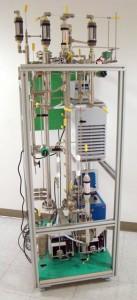 Both solid and liquid phase process test systems (carts) were constructed to allow lab testing (using "synthetic" CO2 containing gas streams) of various materials and also, upon transport to the their real-world test site (a power plant using pulverized bituminous coal as fuel), more "live" conditions testing of real flue gas. Preliminary testing of a solid (zeolite13) and liquid (monoethanolamine) CO2 capture material has occurred, with results as expected. Neither of these materials are expected to end up as a "finalist" for new commercial systems due to known deficiencies in their performance. However, the NPL team has used them a baseline for future materials to be compared against. One of the benefits of the "cart" systems is the ability to use the same systems in the laboratory setting as at the real site at the PGE plant. Being able to test candidates in kilogram quantities with real gas streams is invaluable in generating scalable results, and trustworthy economics in the final (evaluation) phase.
Got Absorbents?
 At the end of his talk, Kriston Brooks put out the call for those with CO2 capture material candidates to contact him about getting his teams to start the stage-gate process on promising options. His e-mail address is kriston.brooks@npl.gov.
Related articles
- Store CO2 Underground and Extract Electricity (nextbigfuture.com)
- A Cheaper Way to Catch CO2 (technologyreview.com)
- Energy Dept. spends $106M to put captured CO2 to use (green.venturebeat.com)