
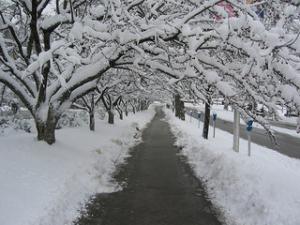
 Scroll down for answer.
QUESTION: Your city in northern Montana is holding a town council meeting on installing heated sidewalks to cut down on the costs of shoveling and plowing snow every winter. As a chemical engineer, you are brought in to consult on the feasibility and cost effectiveness of this design.
An average winter day can bring temperatures of -20?F and 1.5 feet of snow. The town council would like to install the heated portion of the sidewalk in the main downtown stretch of the city. This stretch of sidewalk is 2 miles long and 9 feet wide on each side of the street. The proposal calls for two pipes 8 in. in diameter to run underneath each sidewalk. There is already a steam plant in your town, which provides steam to the city for various utility purposes. The steam, after it has been used, returns back to the plant at 350?C. An idea has been suggested to use the waste steam at the heat for the sidewalk system. The benefit to this is that no extra steam is produced. The initial costs for installation of the pipes is going to be around $50,000, and to pump the steam the additional distance under the streets costs $1.50/kW*hr. The current snow removal system costs $750 per job and takes at least an hour to implement. This current system is used at least 80 times per winter.
To calculate the feasibility of this idea, make the following assumptions: the thermal conductivity of the cement is not important, to idealize the system, the cement is perfectly conductive; the steam in the pipes is at 10 bar of pressure and has a flow rate of 100 kg/s; the final pressure of the steam out is less than 1 bar; the specific heat of snow is 2.108 kJ/kg*?C and the snow has to be heated to 40?F; the snow is 30% by volume water and the density of the air in town is 1.225 kg/m3.
Is the steam pipe proposal a cost-effective way to remove the snow from your city's sidewalks? Explain.
Postscript: This type of snow removal is a commonly used method in northern European countries such as Sweden and Norway.
Scroll down for answer.
QUESTION: Your city in northern Montana is holding a town council meeting on installing heated sidewalks to cut down on the costs of shoveling and plowing snow every winter. As a chemical engineer, you are brought in to consult on the feasibility and cost effectiveness of this design.
An average winter day can bring temperatures of -20?F and 1.5 feet of snow. The town council would like to install the heated portion of the sidewalk in the main downtown stretch of the city. This stretch of sidewalk is 2 miles long and 9 feet wide on each side of the street. The proposal calls for two pipes 8 in. in diameter to run underneath each sidewalk. There is already a steam plant in your town, which provides steam to the city for various utility purposes. The steam, after it has been used, returns back to the plant at 350?C. An idea has been suggested to use the waste steam at the heat for the sidewalk system. The benefit to this is that no extra steam is produced. The initial costs for installation of the pipes is going to be around $50,000, and to pump the steam the additional distance under the streets costs $1.50/kW*hr. The current snow removal system costs $750 per job and takes at least an hour to implement. This current system is used at least 80 times per winter.
To calculate the feasibility of this idea, make the following assumptions: the thermal conductivity of the cement is not important, to idealize the system, the cement is perfectly conductive; the steam in the pipes is at 10 bar of pressure and has a flow rate of 100 kg/s; the final pressure of the steam out is less than 1 bar; the specific heat of snow is 2.108 kJ/kg*?C and the snow has to be heated to 40?F; the snow is 30% by volume water and the density of the air in town is 1.225 kg/m3.
Is the steam pipe proposal a cost-effective way to remove the snow from your city's sidewalks? Explain.
Postscript: This type of snow removal is a commonly used method in northern European countries such as Sweden and Norway.
Kilean Lucas
I am currently an undergraduate at Montana State University. I am about to enter my first senior year as a Dual Degree Chemical and Biological Engineering student and will graduate in Spring 2015 with two bachelors degrees. I am the current AIChE Student Chapter president, after having served as vice-president for two years. After college, I plan to attend graduate school and get a PhD in either chemical engineering or bioengineering.
Scroll down for answer.
QUESTION: Your city in northern Montana is holding a town council meeting on installing heated sidewalks to cut down on the costs of shoveling and plowing snow every winter. As a chemical engineer, you are brought in to consult on the feasibility and cost effectiveness of this design.
An average winter day can bring temperatures of -20?F and 1.5 feet of snow. The town council would like to install the heated portion of the sidewalk in the main downtown stretch of the city. This stretch of sidewalk is 2 miles long and 9 feet wide on each side of the street. The proposal calls for two pipes 8 in. in diameter to run underneath each sidewalk. There is already a steam plant in your town, which provides steam to the city for various utility purposes. The steam, after it has been used, returns back to the plant at 350?C. An idea has been suggested to use the waste steam at the heat for the sidewalk system. The benefit to this is that no extra steam is produced. The initial costs for installation of the pipes is going to be around $50,000, and to pump the steam the additional distance under the streets costs $1.50/kW*hr. The current snow removal system costs $750 per job and takes at least an hour to implement. This current system is used at least 80 times per winter.
To calculate the feasibility of this idea, make the following assumptions: the thermal conductivity of the cement is not important, to idealize the system, the cement is perfectly conductive; the steam in the pipes is at 10 bar of pressure and has a flow rate of 100 kg/s; the final pressure of the steam out is less than 1 bar; the specific heat of snow is 2.108 kJ/kg*?C and the snow has to be heated to 40?F; the snow is 30% by volume water and the density of the air in town is 1.225 kg/m3.
Is the steam pipe proposal a cost-effective way to remove the snow from your city's sidewalks? Explain.
Postscript: This type of snow removal is a commonly used method in northern European countries such as Sweden and Norway.
Comments
"...the specific heat of snow is 2.108 kJ/kg*°C and the snow has to be heated to 40°F; the snow is 30% by volume water and the density of the air in town is 1.225 kg/m3." .... In the preceding comment are we to assume that the 30% of the snow that is water is 30% liquid water with 70% being ice, or that the composition is 30% water/ice with the balance being "trapped" air, in which we can use the air density to get a average snow density. If it's the latter, then I'm correct that the specific heater provided is a bulk material property for the snow.
- Log in to post comments
Hi Jeff,
Sorry for the confusion. The snow is 30% by weight water and the remainder is air. For this problem, you can assume that the energy is all going to the water and does not affect the air. This idealizes the system and makes for an easier calculation. Gool luck and thanks for the question.
Cheers,
Kilean
- Log in to post comments
I'd use the steam to heat an antifreeze solution rather than using steam directly. Even when not snowing, the steam system would have to be kept warm; trap failure could result in freezing and destruction of the system.
- Log in to post comments