

As the US Navy successfully winds up the first "Great Green Fleet" maneuvers off Hawaii, with a nuclear carrier group supported by ships and aircraft burning a 50-50 biofuel blend, UOP, a subsidiary of Honeywell, is building the nation's first dedicated biorefinery on a former pineapple field outside of Honolulu. While Hawaii has been a hostage to tanker-delivered oil for gasoline, jet fuel for planes, and oil burned in outmoded power plants, the military is easily the biggest user of oil on the islands. Between civilian and military use, the state imports 45 million barrels of oil a year, which is getting progressively more painful as global oil prices rise. UOP's new biorefinery will make "a fuel which can be used in power generators, boilers and marine engines," says chemical engineer Jim Rekoske, VP and biofuel guru at UOP. By next year, he hopes to have the biorefinery in place. (Read an earlier interview with Rekoske about UOP's process.)
New biorefinery uses fast pyrolysis
As a demonstration plant, the new refinery will initially produce just five barrels of biofuel a day, which, as stipulated by the $25 million DOE grant, will be given to anyone willing to test it. But once this facility is up and running, it will convert about 1,000 M tons of biomass a day into fuel; the final commercial-scale facility
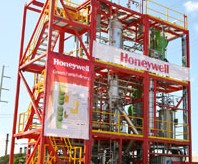
will vaporize and then condense 50 million gallons of fuel a year. The heart of the new refinery is a fast pyrolysis process to transform inedible biomass. Then, after the biomass has been ground into a fine powder, it will float through a chamber where sand heated to 500? C flashes it into oil vapor in milliseconds. After the hot vapor exits, the solids (char) drop to the bottom and burn to reheat the sand. "There is enough heat in the combustion of the char to heat the sand up to a high enough temperature to run the pyrolysis process," Rekoske told Scientific American. The oil vapor, after exiting the rapid pyrolysis, is condensed into liquid fuel, upgraded and processed to make a green fuel similar to the bunker fuel that is used in navy ship engines and industrial boilers, but it lacks the pollution-causing sulfur common to most bunker fuel. This short corporate video (using technology from Enysys Corp) visualizes the process: